







Montessori in a Small Home: Making It Work Without More Furniture
Most Montessori advice was written for people with a spare room. If you are in a Toronto condo or a Vancouver one bedroom, the constraint is not philosophy, it is square footage. The good news is that the core of the approach costs nothing and takes up no space at all.
Can your child reach it, use it, and put it away without you? If yes, it is working. If no, no amount of pale wood will fix it.
The mistake almost everyone makes first
Montessori has become a look: birch plywood, muted felt, a wooden rainbow on an open shelf. The look is genuinely lovely and it is also the most expensive and least important part of the whole thing.
If you buy the aesthetic first, in a small home, you end up with a beautiful room your child cannot move through. The furniture arrives before the thinking does, and the floor disappears.
We sell this furniture, so take the following with that in mind. In a small home, most of what matters is free.
Start with reach, not with furniture
Before you buy anything, spend an afternoon lowering things.
- Move one drawer. Clear the lowest drawer in the kitchen and fill it with your child's plates, cups and cutlery. That single change does more for independence than most purchases.
- Lower a rail. A tension rod in the bottom half of the wardrobe puts tomorrow's clothes within reach.
- Put a stool by the sink. Any stable stool. Handwashing without being lifted is a genuine milestone.
- Clear one low shelf. Not a new shelf, an existing one. Take the bottom shelf of whatever you already own and give it over entirely.
- Hang a hook at their height. By the door, low enough that a coat can be hung without help.
None of that costs anything, none of it takes floor space, and all of it is more Montessori than a new shelving unit.
Rotation is the small home superpower
If you take one practical technique from this article, take this one.
Keep a small number of things out, and everything else out of sight. Perhaps six to eight items on the low shelf, arranged so each one is visible and reachable. The rest lives in a closet, under the bed, on top of the wardrobe. Every week or two, swap a few.
Two things happen. The room stops looking cluttered, because most of what you own is not in it. And things your child had lost interest in come back as new again, which means you buy less.
In a large home rotation is a nice idea. In a small one it is the difference between a room that works and a room you are constantly tidying.
Four zones, not four rooms
You do not need a dedicated playroom. You need four functions, and they can overlap with the rooms you already have.
Why indoor movement matters more here
This is the part that gets left out of guides written elsewhere.
For a good part of a Canadian year, the park is not a daily option. There are stretches of January where getting a toddler outdoors is a forty minute production for twenty minutes of standing about. Whatever gross motor play happens in those months happens inside your home.
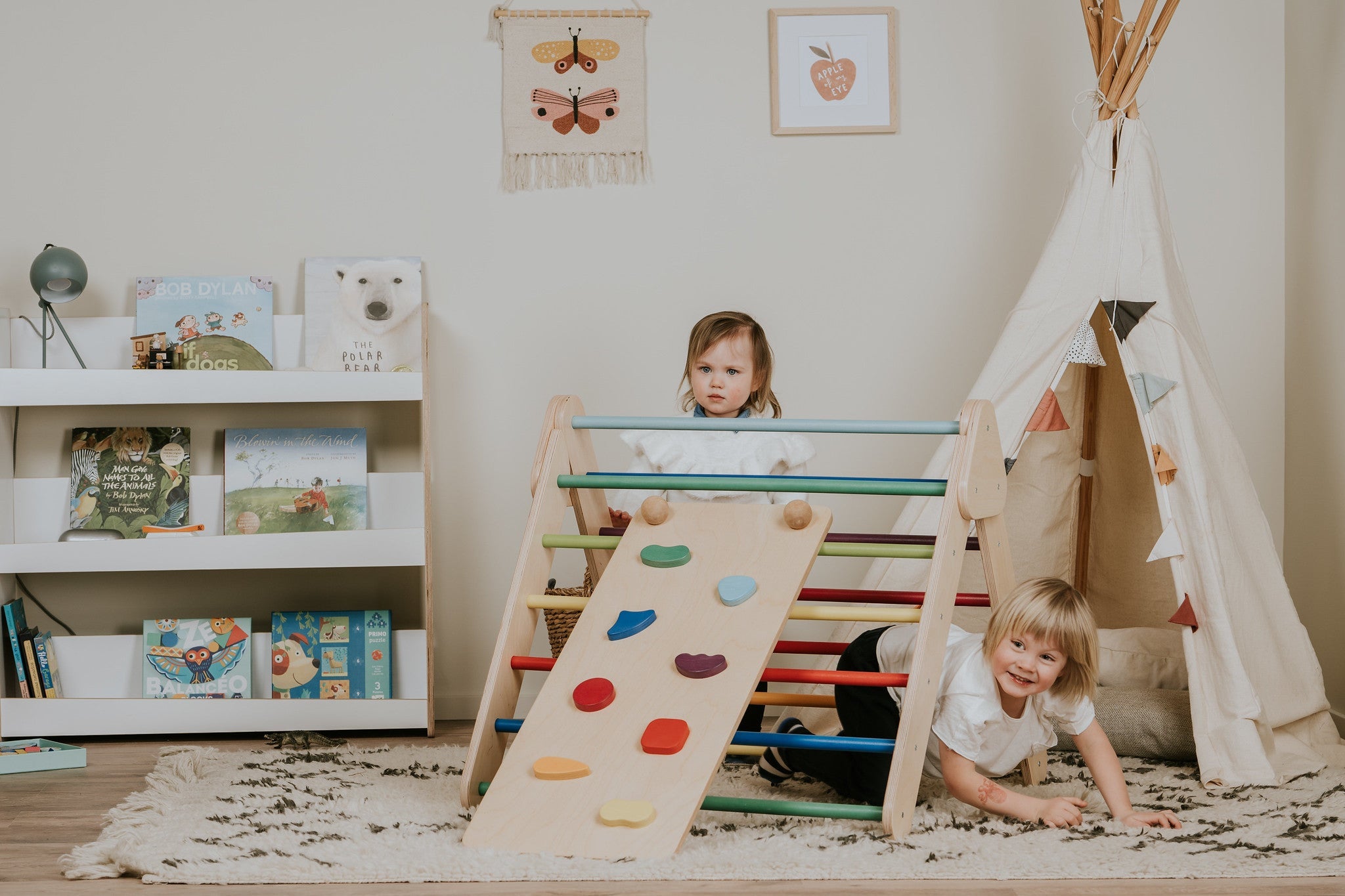
Which changes the maths on a climbing frame in a small space. It is not a luxury item competing with the sofa for floor. It is the thing standing in for a park for several months of the year, and a child who has not moved all day does not sleep well, which the whole household then pays for.
If you own one large item, this is the one that earns it. Look for a frame that folds flat, so it takes floor space when in use and wall space when it is not.
Pieces that earn their footprint
If floor space is scarce, apply one test to everything: does it do more than one job, or does it disappear when it is not in use? Anything that fails both is a hard no.
 Foldable Learning Tower, Ultra Slim
Folds flat against a wall between uses
Foldable Learning Tower, Ultra Slim
Folds flat against a wall between uses
 3-in-1 Pikler Climber Set
Triangle, rocker arch and reversible ramp in one
3-in-1 Pikler Climber Set
Triangle, rocker arch and reversible ramp in one
 Wooden Rocker Arch Climber
Rocker one way, climber the other. Made in Canada.
Wooden Rocker Arch Climber
Rocker one way, climber the other. Made in Canada.
 Cubby Coat and Shoe Rack
Uses vertical space in an entryway. Made in Canada.
Cubby Coat and Shoe Rack
Uses vertical space in an entryway. Made in Canada.
What to skip in a small home
- A second seating piece. Small children rarely sit in child sized armchairs for long, and they occupy floor permanently.
- Multiple open shelving units. One, curated and rotated, beats three that are full.
- A dedicated art table, until there is genuinely nowhere else. The kitchen table with a low chair works, and it does not cost you a corner.
- Large single purpose toys. The test is honest: if it only does one thing and it cannot be put away, it is renting your floor.
- Anything bought for photographs. You will know.
Living below someone
If you are in an apartment or condo, movement play and downstairs neighbours are in direct tension, and it is worth planning for rather than apologising for later.
A thicker play mat under climbing equipment absorbs a meaningful amount of impact noise. Placing the movement zone over a structural wall rather than mid span helps. And the honest measure is simply timing, keeping the loudest play out of early mornings and late evenings. Our play mat sizing guide covers thickness and how to size a mat to a climber.
A word on what this does and does not do
Montessori is an educational approach with a long history and a large body of practitioner writing behind it. What we are not going to tell you is that a particular shelf or bed will make your child more independent, calmer or better at sleeping. We could not stand behind that, and anyone selling furniture who claims it should be asked for their evidence.
What is defensible is smaller and still worth having. A child who can reach their own cup will get their own water. A child with a clear floor will use it. Those are arrangements, not outcomes, and in a small home the arrangements are most of the work.
Where to start
Lower one drawer this weekend and see what happens. If you then want the furniture, start with the piece that solves the function you use most, which in a Canadian home is usually the entryway or the kitchen.
Send us your room dimensions and what you are trying to solve, and we will tell you what fits, including when the answer is that nothing should go in that corner.


Leave a comment